Beyond the Classroom: How Waring School Makes Room for Curiosity
October 27, 2026
Schools love to talk about what they do. Goals met. Awards won. And Waring has plenty of those feathers in its cap.
But Waring also knows that to deliver a real education requires a deeper question: what does a school make room for?
Just ask senior Adam Morrison. On a sunny Friday afternoon, he takes this blog writer away from Waring’s academic buildings, across a back field to a stream that crosses a broken sluice. It dates back to when the school’s campus was a farm.
He’s not sure exactly how many years ago he and his friends started coming out here during lunch and Focus/Flex, the daily free periods when students are responsible for their own time.
He does know that at first, they tried to rebuild the old sluice gate, but they were too successful and the fields started to flood.
So instead, they started noticing things.
Like that in the stream bed, between the water and the packed mud, is a layer of silt. And in the silt is a record of natural and human history.
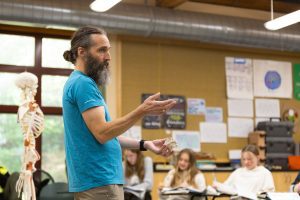
He remembers the day they unearthed a scapula. And then a skull. And brought them to biology teacher Dan Wellehan, who helped them identify the finds as coyote bones, and then think about how Waring’s campus is a crossroads for wildlife, an ecosystem making and remaking itself beneath students’ noses.
And he remembers realizing his time in nature connected to his love of culture, too. For a theater Honors project, he read plays that involve “the wild” (As You Like It, A Midsummer Night’s Dream, The Bacchae) then brought his classmates to the dam and asked them to invent their own scenes. “One was about a bunch of campers…and one of them went off to pee…and got jumped by a zombie,” he says. “That was excellent.”
Did anyone at the school ever ask you to stop digging, this blogger asks, or suggest there were more “productive” ways to use your time?
“Hmmm,” Adam thinks. “Usually, actually they’re telling us to move stuff over here. Like there was an eviscerated bunny” in front of the School Building one morning, and an adult said, can you help “‘get rid of it,’ and so we moved it over here.”
In other words, the school met the students where the students met the world. It made room for their curiosity, let them dig into the earth and their own minds––
and they pulled out some wonders.

